Part 10: The Suspicious Peddler
For the third chapter in a row, we are put in the feet (and hands) of a new character: a cute little monkey! Chapter 3 is where the true nature of Mother 3 reveals itself, and darker elements start to overshadow everything that’s come before.
A futuristic spaceship-looking vehicle lands in a desert. Out of it emerges a group of Pigmasks who move to their positions, making pig noises as they give solutes eerily similar to that of the Nazi party’s. The last Pigmask to come out brings a cute little monkey, and angrily kicks him down the stairs of the aircraft. Another monkey wearing a bow and lipstick tries to run to the first monkey’s aid, but the Pigmasks forcefully separate them before they can reunite. We are then shown the name of the next chapter:
Chapter 3: The Suspicious Peddler
The mysterious man we saw at the start of Chapter 2 who gave Butch money returns at the beginning of this chapter as well. It turns out, he is indeed evil.
The name of this Suspicious Peddler is “Fassad.” His name is a pun in three different languages. In Arabic, ‘fasad‘ means ”corruption’, as he looks Arabian and is evil. In French, ‘façade’ refers to a false appearance, as he appeared friendly to Butch and the other townsfolk, but we now know this to not be his true manner. In Japanese, he has a different name, Yokuba, a pun on Yokubari, which is a description of greed. The name “Fassad” is unofficial, and was a creative liberty taken by the fan translation team, since no English speaker gets the significance of “Yokuba.” Personally, I think his English name is warranted and clever.
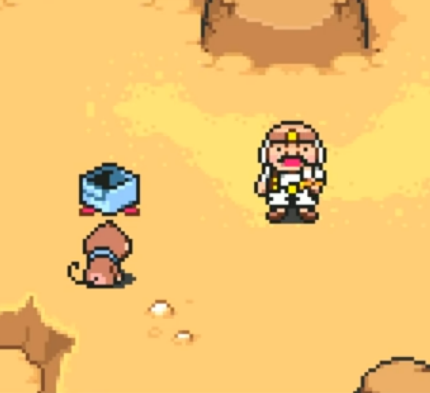
However linguistically clever his name is, Fassad is a man of action over words. He gives the monkey a very painful electric shock as an example of punishment. He explicitly mentions the advanced technology that went into the creation of his shock collar, and that wherever the monkey goes, he will never escape the range of punishment. He also threatens both the monkey and his girlfriend with death if he does not follow orders. After all this warning, he prompts the monkey to come up with a name for himself, giving a stupid laugh at the end: “Nwehehehehe!” So far, everything about Fassad is designed to make you hate him. There is no redeeming quality to be found in him. For how colorful this game is, it has some realistically dark themes.
The default name for the monkey is “Salsa.” The game describes him as “A monkey who will endure anything for his girlfriend;” a force of good. After being given a name, Fassad says the following:
“Alright, stupid monkey! Salsa! I’ll only say this once, so listen close! If you wanna enjoy this little journey with me, just remember these two things: You and I are buddies… Don’t you dare try to run away from me. Always behave, and act nice and friendly. Got that? The second thing to remember: never disobey my commands. If I say dance, you dance! If I say laugh, you laugh! It’s that simple. Got it?!”
If you answer “no” to either of these instructions, Salsa will get shocked, and will continue to get shocked until you answer “yes.” These orders don’t seem like they should be coming out of Fassad’s mouth, as he is anything but nice and friendly. He is aware of what it looks like to be good, but actively chooses to a different way.
Fassad notices a defiant look in Salsa’s eyes. Therefore, he orders Salsa to dance for him. If he does not dance, he will get shocked until he does. When he does dance, Fassad says, “That’s such a silly monkey dance that just watching it is embarrassing!” He also orders Salsa to dance again, laugh, and do a backflip. He mentions that everyone will be convinced that Fassad and Salsa are a performance duo.

Salsa’s girlfriend is dragged back into the aircraft, and Salsa runs after her. Unsurprisingly, he gets shocked for doing so. The Pigmasks line up and re-enter it. The last one kicks Salsa to the ground. The aircraft flies away, and Salsa is left with only Fassad in the middle of a desert, with no one to help him. He starts to shed tears. Fassad responds, “Hey, you stupid monkey! You only get to cry when I tell you to! No crying on your own! It’s punishment time!” and proceeds to shock him.
The Pigmasks and Fassad have so far only shown hatred and cruelty. Salsa was dragged away from everything he knew and loved to be a slave to Fassad and his dubious agenda. This, along with Flint’s outburst from chapter one, are examples of the corruption in the world. Flint shouldn’t have attacked the ones who saved his children, and Salsa never deserved the fate he was given. Yet, those events still took place. Never before have I played a video game that covers such real topics as Mother 3. This game isn’t only meant to be played – it’s also meant to be felt. But why would anybody want to feel a game that makes you feel as bad as this, though? While it does have its depressing moments, it has an equal amount of funny moments; is that not what life is like? To me, this game represents the human experience, and is a reminder of the state of the world in which we live. It’s a very mature game, not in the sense that blood splashes everywhere, but in the gravity of its message. This game isn’t all happy, but by having sad moments, the good moments feel so much more authentic.
Anyways, Fassad tells Salsa that they’re headed to a white, round building west of them. He doesn’t explain why, but expects the instructions to be sufficient reason enough for Salsa to go there. This begins another “gameplay section,” where you go from one point to another, fighting hostile animals and monsters along the way and checking out detours. One such detour is the oasis, where you can talk to a dung beetle named Wan Sum Dung, who doesn’t have any dung to roll. If you give him some dung, he will reward you with experience points.
When you come across a banana, Fassad takes it from you and eats it, throwing the peel on the ground. As we all know, monkeys love bananas. When Fassad takes it, he is symbolically destroying Salsa’s livelihood and leaving its remains to rot. Itoi wants to make it crystal clear that you aren’t supposed to like this guy.

There’s a hidden area in the desert where you find a save frog spiraling down quicksand. If you choose to rescue the frog, you have to fight a surprise enemy called the Great Antlion. Antlions are bugs that dig pits and hide inside them so that when unsuspecting creatures slide down, they are eaten by it. Next to the frog is a sign that says the following:
“Frogs in a desert? It’s not actually as crazy as you might think. Some species of frogs, such as ‘sand frogs’ do exist in arid, desert regions like Africa. During seasons with little to no precipitation, these frogs burrow into the ground to protect themselves from the harsh, dry climate.”


Why is this sign justifying the existence of a frog being here? It’s a fun fact, don’t get me wrong, but why is it here? Additionally, why is it mentioning real-world locations like Africa, in a game that takes place on the Nowhere Islands? This is a direct message from Shigesato Itoi to cheer up the player, who has just witnessed some terrible things take place. This game has so much emotional whiplash in it, you can’t help but laugh – and that’s why I love it.
My single favorite way Mother 3 uses its battle system to portray a story is found in this section. When you battle monsters in the desert, Salsa is pitifully weak. For example, Sand Lizards have 76 health points, but Salsa can only take away about 15 each turn, while only having about 50 health points of his own. Salsa is strictly outmatched by common animals in the wilderness. The only way to ever win these battles is with the help of Fassad, who can do up to ten times more damage than him. The player has no control of what Fassad does; he can either save your life or twirl his mustache – whatever he feels like doing. This portrays the tragic dependency that Salsa has on Fassad, his owner. Even if Salsa could escape, he would just die in the desert out of a lack of strength. There is absolutely nothing that Salsa can do to save himself. His life is in the hands of a cruel manipulator.
The song that plays in the desert is pretty lighthearted. The desert itself is in no peril; why should it be sad? The melody at the beginning makes it sound kind of mysterious, I think because of the instrumentation and the scale at which it’s played. It’s typical desert music. But then around the 20 second mark, it turns adventurous, with all sorts of instruments being played. Interestingly, an accordion is in the mix, which you wouldn’t really expect to play in a desert setting. This part could either be interpreted as “exploring a new environment” or “Fassad on an important mission,” or both.
Once you find the building that Fassad was talking about, you find a Cactus Wolf lying right in front of the entrance; it’s a wolf with a cactus on its head, since everything has to be themed around deserts, of course. This serves as the boss for the desert area. When Salsa attacks it, he only does 1 damage out of the Cactus Wolf’s 400 health points. If you never got the point that you have to rely on Fassad to win battles, you will here. When the boss is defeated, Fassad shoves Salsa into the building and follows him inside.

Inside this dome in the desert, there is an elevator that leads to an underground tunnel. Further inside, Fassad introduces Salsa to the Pork Bean, a high-tech vehicle that moves at extremely high speeds. Fassad says, “We’re going to take it to an unbelievably uncivilized village called Tazmily.” It’s clear that Fassad and the Pigmasks greatly value their technological superiority. In everything they have done so far, it has been through the use of advanced technology: they have laser guns, tanks, aircrafts, bombs, and underground tunnels. Whatever they are doing to Tazmily, they can absolutely succeed in it. Pretty much every structure in the village is made out of wood; all the Pigmasks would have to do subdue the town is burn it!

There’s a special song that plays when you ride a Pork Bean. It uses the Pigmasks’ theme, just in case you forget what you’re inside. The second part of the song is new, and it will be used in a few other songs. The instruments are synthetic and electric, to let you know it’s a high-tech vehicle.
Near the end of the Pork Bean’s road, you can see where the Pigmasks keep their tanks. Additionally, when you reach the end of the tunnel and get back above ground, you enter through a secret passageway hidden underneath one of the graves in the graveyard. Whatever the Pigmasks are doing, it has been long premeditated.


Fassad instructs Salsa that they are headed to the Yado Inn. Normally, you’d be able to freely explore the village, but if you go in any direction other than the way to the Inn, Fassad will shock Salsa. It is currently nighttime in the village, and the song that played in the desert is still playing here. I think that’s an odd detail. Either the song is meant to convey Fassad’s ambitions, or they just never made a song for this short sequence. In my opinion, it’s out of place for this setting. By the way, why is it night all of a sudden? When you went through the underground road, there was a section that was above ground that showed the forest at daytime. I think there was a missed opportunity to turn the grass and trees yellow to show the player that the sun was setting. In any case, I’m just nitpicking.
When you enter the town square, you can see Butch counting his money in the same place he was at the start of Chapter 2. Just a few steps further, you run into Duster. Fassad uses the exact same dialogue he did when Duster met him in chapter 2, and Salsa gives Duster the same sad look he did before slowly walking away. Butch’s money bag has not yet been stolen, and these events are taking place at the same time as chapter 2’s. Fassad and Salsa hide behind the well as they watch Butch hide the money in it. He then lets out another “Nwehehe!” All is going according to plan.


This concludes part 10 of the analysis.