Part 3: Search for Family
Flint runs home to see if Hinawa, Lucas, and Claus made it back safely. The only one that greets him is the pigeon Hinawa sent.
Flint reads the letter, and its heartfelt contents crawl up the screen just as it did when Hinawa wrote it, playing the same song as before, but with a music box as the only instrument. Accompanied with the sound of rain, this message is enough to send chills down your body. It’s amazing how the same text and the same melody can create two completely different emotions depending on context. When you read the letter the first time, it brought the same sense of love that Hinawa had when she wrote it. But when it’s read by Flint, you are distraught that she still hasn’t returned, contrary to the letter’s promise. The strings of togetherness that came in the first time we heard the song are no longer here, and all that plays is the music box of an empty home.
The town is troubled by Hinawa and the kids’ absence, so they team up with Flint to search for them. Boney joins you as well. Before you enter the forest, you encounter an old man, named Wess. He claims to be quite strong, but nobody lets him help because of his age. Now that it is raining and the fire is put out, it is safe for Flint to go through the woods. Since there was a fire, a lot of the trees that were once there are now gone, with burnt patches of grass in their places. The Yammonsters that you encountered when the forest was burning are now ‘Baked Yammonsters’.


As you walk down the forest, you find that just about everybody who is able is searching for Hinawa and the kids; they are well-loved by the community. However dire the situation is, most people have a positive attitude, confident that they will find them soon enough. You can talk with Jill, who’s part of the gossip group, and she tells Flint that due to Claus’s mischievous nature, he is probably just hiding from everyone, and that Lucas is probably crying like the wimp he is. This, along with the group she’s seen talking with, reveals a pessimistic nature. Jill is completely obsolete from the story, yet she has definable traits. It isn’t just her who has character traits – everyone in Tazmily has their own personalities and lives! This may not seem very significant, but in a lot of video games, hardly any characters have personalities – even the main characters. A lot of people in games don’t even have names! This makes Tazmily seem like a much more realizable place.


The song that plays in this area is much calmer than the song that played when the forest was on fire, but is very much still tense. The horns are drawn out in a minor key, creating a sad atmosphere to your mission. Interestingly, the bass goes really fast compared to anything else in the song. I have thought of two reasons why it could be this way: the first is that this is a very urgent scene, so the bass hurries along with Flint; the other instruments exist to make the song sadder. Another way you could interpret the fast bass is that it’s supposed to symbolize the speed at which the rain is falling; after all, the song is called ‘Hard Rain.’
When you get deeper into the forest, you come across a very peculiar area. Trees are snapped in two and deep gashes are clawed into the cliff towering over them. This couldn’t be a result of fire, so what could have caused it? Lighter, the very same night he was covered in bandages, comes along with Isaac to help move a pile of trees that are blocking the way forward. Fuel adds, “My dad lives life with lots of energy, so he’s not like regular people. Mr. Flint, my dad will do his best!” This is another example of Itoi trying to bring his insight into this game. He encourages us to be lively and have spirit, or else we’ll be stuck in bed even if we aren’t caught in a fire.


As Flint looks for another way forward while Isaac and Lighter try to remove the fallen trees, Jonel says that the gashes in the clifface are most certainly from a Drago. He then goes on to say with huge foreshadowing, “I get the feeling something very bad is happening to the forest, the people, the animals, and me.” Boney sniffs around, and finds a scrap of red cloth stuck on a tree branch. The camera takes a cinematic shot of the cloth, with a single flash of lightning striking the air. Indeed, something very bad is happening to the world of Mother 3.

Wess, the old man who wasn’t supposed to help, defiantly reaches the area where everyone else is. Wess wants to bring his son over as well, whose name we get to choose. The default name for him is “Duster,” who the game describes as “a strange, but nice guy with unexpected skills.” ‘Wess’ and ‘Duster,’ in Japanese, are supposed to be a play on the words ‘broom’ and ‘dustpan,’ like the other father-and-son pair, ‘Lighter’ and Fuel.’
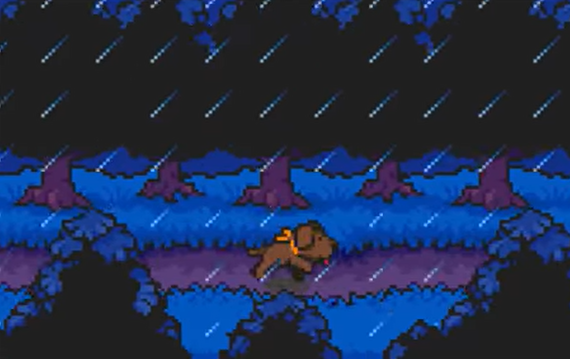
To bring Duster over, Wess enlists the help of Boney the dog. He is given a whiff of Duster’s smelly sock, and an orange bandana is put around his neck, which Duster will understand as a sign. The game then has a cute little cinematic of Boney running back to Tazmily and sniffing his way to Duster’s house. When he finds Duster, he is sleeping, and Boney drags him all the way back to the forest where Flint is. Once Duster wakes up, he runs right behind Boney.
When Duster arrives, Wess gives some interesting dialogue: “Duster… At long last, it is time to put the thief skills you’ve studied since childhood to the test. Now, show us your Wall Staple technique! Right here, right now!” Duster goes on to stick staple-like rungs onto the cliffside to scale it, since the fallen trees are currently blocking the other way through. Flint, as well as Boney, climb up the wall staples to continue on. Duster implores that, despite having a slight leg handicap, he will be helpful on Flint’s journey, and joins your party.


Once Flint and Boney scale Mount Oriander, as we learn it to be called, the rainfall finally ends. You can walk over to the tree and retrieve the scrap of cloth that was stuck on it, with the game eerily mentioning that it is the same color of Hinawa’s dress. Usually, when you pick up an item in the game, a fun and quick little tune plays. But when this cloth is picked up, the tune is not so fun anymore, but sad and descending.
The song that plays when the rain is over is also rather sad. The flute goes up and down over and over again very uneasily. The long, drawn out strings play an ominous melody, reinforcing that something is not right. The song is enough to make your stomach sink. The strings play the same melody as when Flint first made his way to the forest.
Right after finding the scrap of cloth, Flint and company encounter two of those pig-masked people, or whatever they are. They are working with some kind of technology, next to what looks like a caribou that’s half natural and half robotic, having one antler made out of metal. The mysterious people notice Flint and are startled. Without making any noises besides pig squeals, they power on the caribou. The LED lights it has for eyes turn on. It makes an aggressive snort, and charges at Flint and his crew. This is the first ‘boss battle’ of Mother 3.


This is the strongest enemy you have had to fight against so far. The Reconstructed Caribou’s attacks do far more damage than any of your party members’. Its only weakness is that it must literally blow off steam in between attacks, something that no normal animal ever has to deal with. The modifications made to this animal make it far stronger, but at what cost? While its actions are enhanced, it can hardly function without having to idly burst off steam all the time. What if its exhaust pipe is broken? It will never grow back, unlike the antler it was replaced by, and the caribou would internally combust. Though it may be strong, it is only held together by screws, which can never replace the natural, yet seamless complexity of bones and muscle. If its batteries never get charged, this animal is doomed to die in the wild. In fact, its life already ends as Flint, Duster, and Boney beat it in battle. They were forced for the sake of their own lives to kill this already ruined caribou. If it hadn’t been for Duster’s staples to pin it down, it likely would have been the end of their own story. Whatever villanous power is behind this eco-terrorism must be stopped before any more life is ‘improved’ to death.
The song that plays during this battle also reflects the tragedy of the Caribou; the title itself does as well. The composition is very classical-sounding, and that’s because it is: it has significant similarities with Beethoven’s Symphony no. 3. As I will state throughout this analysis, Shogo Sakai takes very heavy inspiration from all kinds of pre-existing music, including his own works. The melodies introduced in Chapter 1 will be reused and remixed all throughout this game. New music is made by combining other songs that one has in their memories, and Sakai has a wide variety of memories that he inserts into this game’s soundtrack. The heavy use of popular music was also a trend with the EarthBound series even before Sakai worked on its music for Mother 3. The previous composers, Keiichi Suzuki and Hirokazu Tanaka, put parts of various popular songs into the games to make it more earth-bound. The atmosphere of the game is meant to resemble that of our own world, so it uses music from popular culture to be more relatable.
Anyways, this particular song uses Symphony no. 3 in a very appropriate place, with the melody itself sounding like it’s saying “Oh, the humanity!” at the Reconstructed Caribou, with its life ruined for seemingly no justifiable reason. It creates this impression with the notes going very high and very low, very close to each other. The drums, along with the horns at the end, make you feel like you are being stopped by a large, heavy force, which a caribou partially made out of metal would be.
Once the Caribou is been defeated, the two pig-masked people run away in a panic and fly away in a spherical, flying vehicle, dropping a peculiar notebook. When you read it, it says, in poor handwriting,
“All of the creatures around here suck. We need to make ‘em cooler. So the theme will be:
-Tougher!
-Rougher!
-Badder!
We’ll mix and match this and that to create whole new things that no one’s ever seen before! I dub it, “The Fascinating Chimera Project.” Let’s reconstruct and modify stuff slowly and steadily.”
What a spit in the face to nature! This reveals the intent of these villains: make animals look cooler – that’s all there is to it. What a terrible reason to do such things to these poor animals! The ‘fire flies’ have already burned down the Sunshine Forest; imagine what worse things these villains might have in store! But this is not the first priority for Flint. Before anyone worries about that, he must rescue Hinawa and the kids back to safety.
What is a ‘Chimera’? As the game progresses, the theme of chimeras will be extremely prevalent. Simply put, a chimera is a fantastical beast with attributes of many different animals, such as a lion with an eagle’s wings. In Mother 3’s case, it’s a combination of two different things. This will be extremely important to remember later on.
This concludes Part 3 of the Analysis.