Part 4: The Night of the Funeral
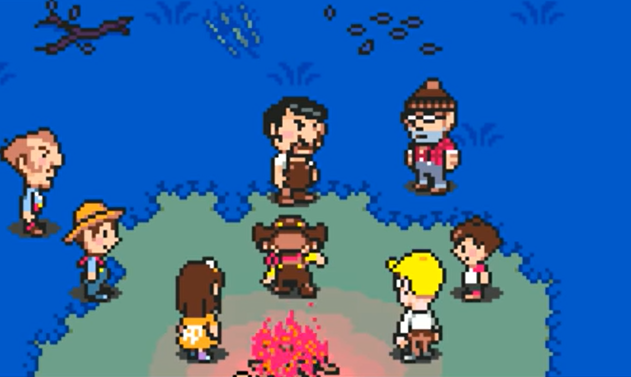
After defeating the Reconstructed Caribou and investigating its technology, Flint, Duster, and Boney find that a natural bridge across the mountain has crumbled, and that they have met a dead-end. When they return back to where everyone else is, Jonel announces that they found Lucas and Claus! They washed up from the river to where the search party was. As you make your way to the campfire they set up for them, you can talk to some of the villagers to hear their thoughts on the situation. A lot of them mention that Hinawa is yet to be found, but they are confident that she is safe. Meanwhile, Bud and Lou are cracking jokes about how they’ll kick the butt of anyone that would try to hurt Hinawa. What a terrible time to say that! When you finally see Lucas and Claus, they rush toward their father to hug him. They are wrapped up in a blanket, next to the fire.
What happens next is the most important scene in Mother 3; make sure to watch this next video:
Bronson runs down to the campfire as fast as he can, with two pieces of breaking news: one good, and one bad. The good news is that he found a Drago fang, which could be used to make a very powerful weapon. The bad news is, which he says hesitantly, is that the Drago Fang was found pierced through Hinawa’s heart.
Hinawa is dead. Flint’s very own wife was viciously killed by a creature that has never hurt anyone before. She left to go to visit Alec, and she never returned. Why did it have to be this way! If only Flint were there to protect her! Tazmily had never had problems before, and the first bad thing that happens is that Flint’s wife dies! What a terrible, cruel world! What if Flint had made it to her before the Drago killed her? What if he had cleared through the trees faster? Why did it have to be this way? Flint is broken beyond words. He drops to the ground and punches the very earth he inhabits. In fierce rage, he reaches his hand into the fire, grabs a stick, and beats anyone unconscious who dares to try comforting him. It would have been better if Flint, too, had died to the monster, because he never would have had to live through the agony of his wife’s death. Lighter, the one whose life he was able to save, is forced to knock Flint out before he spreads any more pain to anyone else. In an unconscious state, Flint dreams of the last time he saw Hinawa. As they part ways, Flint takes one last gaze at the one he loved most. In Flint’s vision, she is the only thing he sees, surrounded by an intense light. They say goodbye, and she leaves the world forever.
This was a beautifully crafted moment. Everything about it was intentional, even the dialogue Bronson says in the beginning about good news and bad news. Even in the darkest moments of the game, Mother 3 cannot stay completely serious. Just before this, we heard Bud and Lou working on their comedy routine when Flint was going to see his children after all the trauma they went through. Now, when Bronson delivers the saddest information Flint has ever heard in his life, he calls it ‘good news’ and ‘bad news.’ Despite that supposedly terribly-written line, you probably still felt emotional when you watched that video. I’ve played this game about five times now, and my heart still sunk watching it again. It’s almost like that line was written to bring the whole scene down a notch, which it indeed was meant to do. In an interview, Itoi says, “No matter how you look at it, it is just a game, and it’s not a true story. So to get this point across, I tried to make it as exaggerated as I possibly could. When Bronson tries to break the news of Hinawa’s death, he says, ‘I’ve got good news and bad news’. But didn’t you find that to be a rotten thing to say?” I think this is a very mature way to play out a very mature scene, even if it sounds stupid at first. It’s okay to cry at the scene, but it’s not okay to be so immersed that you actually become depressed about a made-up story, or about anything, truthfully. As I’ve tried to point out, it should be clear that this game wants to help you grow as a person, with philosophical advice being given out every now and then. The game could not help you if it genuinely hurt you with a scene so painful.
The level of animation that each of the characters has brings so much life to this scene. None of the character animations you see in this video are ever reused throughout the rest of the game again – they were made specifically so this scene would hit you as hard as it could. To the person playing the game, this much realism may have been shocking, since the closest depiction of violence you get up to this point is during battles when it says, “[Character] hit [Enemy]!” There is a distinct lack of violence in the battles of this game. When you’re “re-sensitized” this much, anything would be shocking, just like it was for the characters of the once-peaceful villagers of Tazmily watching it play out.
The final moment where Hinawa looks at the camera before walking away into the light was especially touching. This was why the game let you play as Flint: so that this scene would hurt you as much as it hurt the one who loved her most.
I have to analyze the music that plays here. Described in one word, it is ‘Confusion.’ The piano plays some very broken chords that don’t sound right. This is a reflection of Flint’s shock of hearing Bronson’s message. The melody of the song after the broken start is quite mournful, as if ‘taking it all in.’ Flint lost the most important person of his life, and this depressing song suits the situation well.
When Flint has his vision of Hinawa leaving, a very important song plays: the Love Theme. If you can recall to the beginning of the game, when Lucas played outside with Claus, the same melody was present. This song seems to represent the family, and the love they all had for each other. A music box is the initial instrument, symbolizing intimacy, which transitions into a grand collection of strings, and ending with a few notes of the music box once more. The melody of this song is very simple—you can even play it with one finger on the piano. This was done intentionally by Shogo Sakai, perhaps to symbolize the simplicity of the nature of love. It really is quite easy to love, but the intensity of emotion that it brings is like none other, reflected by the orchestra. The melody is cut short in this version, compared to ‘Mom’s Hometown.’ My guess is that functionally, Itoi didn’t need the flashback scene to be very long to get the point across. Artistically, Sakai may have made the decision to make it sound like the music was leaving as well with Hinawa. The strings slowly descend and the music box from the beginning concludes the scene, ending it where it began. The strings were leading to this moment; by the end, they all started to descend, as if dying off. Hinawa is truly gone, and nothing can change that.
When Flint finally regains consciousness, he finds himself in jail. Bronson enters and declares Flint as the first person in Tazmily to ever actually be thrown into it. However aggressive Flint was, Bronson is still sympathetic towards him, saying to him, “Take it easy here for a while. I know you must be having a hard time with this, but try and get some sleep.” The jail seems to be less so for punishment than it is for helping Flint come back to his senses, forcing him to comprehend everything that just happened, and keeping everyone safe from any more outlashes he might have. It seems like everyone in Tazmily truly loves one another and wants the best for its neighbor, even willing to forgive any violence one may cause out of shock. Bronson also remarks about how peaceful the Dragos always were, alluding to the sentiment that something is going wrong. Lastly, he tells Flint to come to his house to receive the Drago fang once he gets out of jail, still letting him have it after everything he’s done.
After Bronson leaves, the player regains control over Flint. However, he can’t do much behind bars. The player may spend a long time figuring out how to leave, which represents the length of time that Flint is stuck in there. To leave the jail, the player has to walk around the cell a little bit and interact with the few objects that are in there, which is not too obvious. When the player finally does that, it triggers Claus to come and visit his father. He says that he tried to bring Lucas along, but he’s still crying at his mom’s grave. He gives Flint a gift in the form of an apple, suspiciously telling him to make sure to eat the core, which is hard for some reason. Claus’s parting words are, “I’m gonna get stronger… I’m gonna get so strong even the Dragos won’t stand a chance against me! Dad… I…” Without finding the words to finish his sentence, Claus runs off. Inside the apple, was, unsurprisingly, a hand file to break the lock of the door. But by the time Flint escapes, Claus is nowhere to be found. Where did he go?

Standing right outside the jail, as if waiting for Flint to come out, Duster informs him that Hinawa’s burial ended without incident and that Lucas has been crying at her grave ever since. His dialogue ends with him offering Flint help in any way he needs it. Once more, his neighbors are supportive of him, despite his past actions. And again, we are informed of Lucas’s broken heart over Hinawa’s death, further establishing his sensitive nature.

This concludes Part 4 of the Analysis.